Crack and Resubmit vs Crossover: Challenging a Centering Grade
Crack and resubmit or crossover? How each path works, why the 55/45 front line blocks most upgrades, where back centering opens a door, and the 2026 fee math.
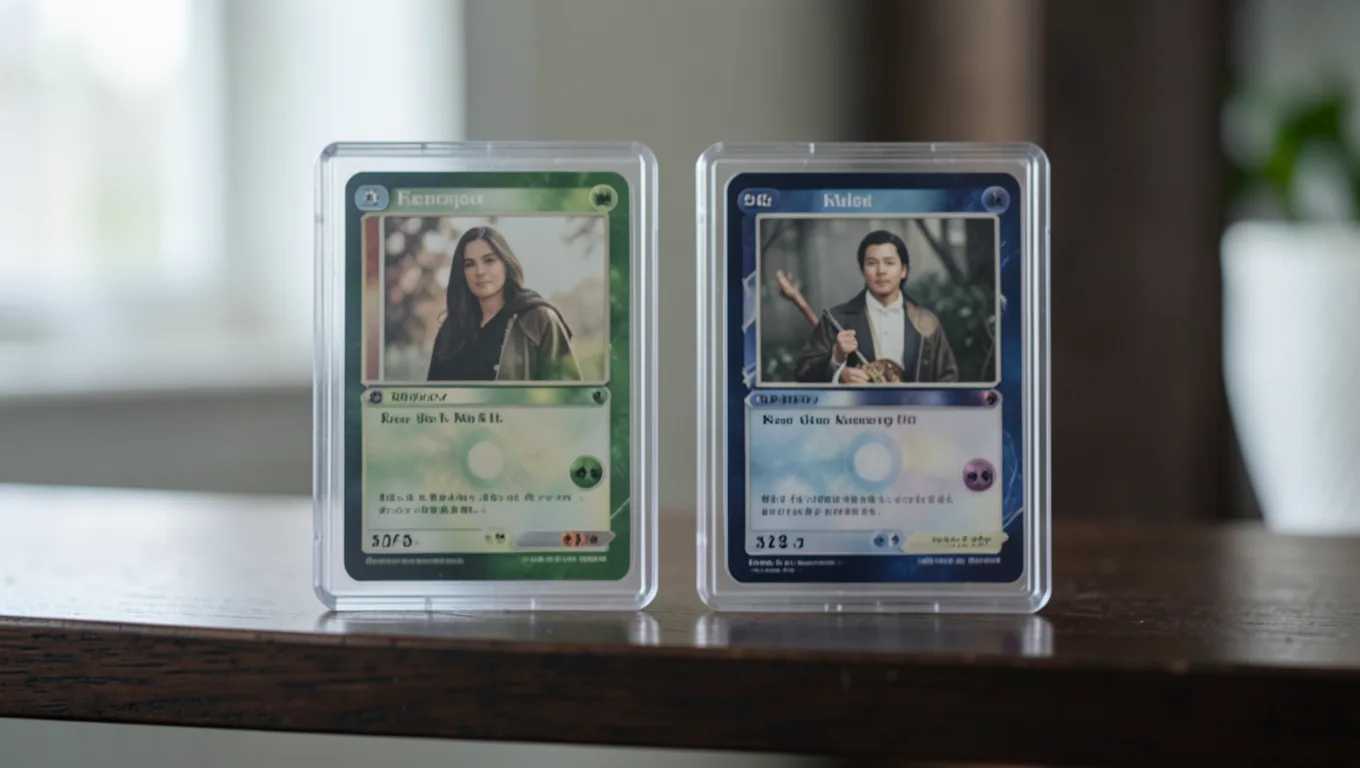
You have a graded card and you think the centering was judged harshly, or you think a different company's published tolerance would treat it better. There are two ways to act on that, and they are not variations on the same idea. Crossover keeps the card sealed and the old grade intact until a new company agrees to beat a number you set. Crack and resubmit destroys the grade you have before anyone has promised you a better one.
Centering is the one criterion where you can actually run this decision on arithmetic instead of hope, because every major company publishes a ratio for it and because centering never changes. Corners can be misjudged; a border cannot. Measure the card, compare it to the published ladders, and the answer usually falls out.
The uncomfortable finding, which the rest of this article works through, is that for a front-centering miss at the top grade there is almost nowhere to go. The Gem-level front line clusters at approximately 55/45 across the industry. The genuine opportunities are on the back, and at the 9 level.
The two paths, side by side
| Crossover | Crack and resubmit | |
|---|---|---|
| Card status when it ships | Sealed in the original holder | Raw, after you break the holder yourself |
| What you specify | A minimum grade you will accept | Nothing; you take whatever comes back |
| If the new company will not meet your number | The generally understood outcome is that the card returns in the original holder, old grade intact | Not applicable; the old grade no longer exists |
| Worst realistic outcome | You are out the fee and the shipping | A lower grade than you started with, or a damaged card |
| Physical risk to the card | Handling and shipping only | Cracking the acrylic, plus handling and shipping |
| When it makes sense | Your measurement meets the other company's published line | You believe the original grade was wrong for a reason you can name, and the spread is large |
There is a third, quieter option worth naming: reholder with the same company, which replaces a scratched or damaged slab without re-grading. That solves a presentation problem, not a centering one.
A note on how crossover is described here. The mechanic above is what is generally understood across the industry and is how the service is commonly described, but each company sets its own eligibility rules, minimum-grade options, fee structure and handling of declined crossovers, and those change. Confirm the current terms on the company's own site before you ship anything. Nothing in this article is a substitute for that page.
Why the front rarely gives you a door
Put the published front tolerances for the top grades next to each other:
| Company and grade | Front centering | Back centering |
|---|---|---|
| PSA 10 Gem Mint | approximately 55/45 | 75/25 |
| CGC Gem Mint 10 | not to exceed approximately 55/45 | not to exceed 75/25 |
| SGC 10 Gem | 55/45 or better | not published |
| BGS 9.5 Gem Mint | 55/45 both ways | 60/40 or better |
| BGS 10 Pristine | 50/50 all around | 55/45 or better |
| CGC Pristine 10 | 50/50 | not stated |
| SGC 10 Pristine | 50/50 | not published |
| TAG 10 Pristine | approximately 51/49 | approximately 54.5/45.5 sports, 52/48 TCG |
| TAG 10 Gem Mint | approximately 55/45 | approximately 70/30 sports, 65/35 TCG |
All figures from the companies' published standards as of August 2026; the complete ladder for every grade is in our centering tolerance table and the grading standards guide.
Read the front column. Every Gem-level line above is 55/45, and the Pristine lines are tighter, not looser. So if your card measures 58/42 on its worst front axis, none of the standards in that table says it should get a top grade. Crossing it over is paying a second company to apply the same number. That is the single most common wasted submission in this whole area.
The only softness on the front is PSA's, and it is discretionary rather than a different number. PSA writes "approximately," adds a footnote that "at the grader's sole discretion, a small variance may be permitted on occasion based on the card's overall eye appeal," and publishes a 5% leeway on front centering minimums for cards grading 7 or better. That leeway makes PSA the most forgiving destination for a borderline front at the 9 level in particular, where PSA's own example says a 60/40 card automatically meets the front standard for a 9 and a 65/35 card may be deemed to meet it if eye appeal is good. Note what that does not say: it does not create a looser 10.
Where the back opens a real door
Backs are the interesting part, because the companies genuinely disagree.
| Grade level | PSA back | CGC back | BGS back |
|---|---|---|---|
| Top grade (10 / 9.5) | 75/25 | 75/25 | 60/40 at 9.5, 55/45 at Pristine 10 |
| Mint (9) | 90/10 | 90/10 | 70/30 |
| NM-MT (8) | 90/10 | not stated | 80/20 |
The gap at the top is large. A card whose back measures 68/32 is inside PSA's and CGC's 10 line by a comfortable margin and outside Beckett's 9.5 line by eight points. Backs are routinely worse than fronts, because the front and back are printed in separate passes and registered to the sheet independently, then a single cut splits the difference between them. So this is not a hypothetical case; it is the normal state of a lot of cards.
Worked example. You own a BGS 9 with subgrades of 9.5 for corners, 9.5 for edges, 9.5 for surface and 9 for centering. Beckett's final-grade rule weights the lowest subgrade most heavily, so you know exactly what capped the card. You measure it: front 53/47 on the worst axis, back 66/34.
- Against Beckett's ladder: front 53/47 clears 9.5; back 66/34 fails the 9.5 line of 60/40 and meets the 9 line of 70/30. The 9 is correct.
- Against PSA's ladder: front 53/47 is inside approximately 55/45; back 66/34 is inside 75/25. On centering alone the card qualifies for a 10.
That is a crossover worth attempting, with the minimum set at 10. Note the honest caveat: PSA will also re-judge corners, edges and surface, and Beckett's 9.5 subgrades there are encouraging but not binding on another company. You are betting on a measurement, not buying a certainty.
The reverse case, which is more common and less encouraging. You own a PSA 9 whose front measures 57/43. You want a BGS 9.5. Beckett's 9.5 requires 55/45 both ways on the front. You fail by two points, at a company with no published leeway clause. There is no crossover here, and no crack and resubmit either. This card is a 9 everywhere, and the correct move is to sell it and buy a better-centred copy.
If you want the full centering-only crosswalk between the top grades at each company, it is in PSA 10 vs BGS 9.5 vs CGC 10 vs TAG 10.
A decision table by measured ratio
Measure both axes, front and back, before you read this. If the card is in a holder you cannot open, measure through it and widen your error bars by a few ratio points. The free centering calculator will take a straight-down photo and let you place the guide lines yourself.
| Worst front axis | Back | What to do |
|---|---|---|
| 50/50 to 52/48 | inside 55/45 | Pristine territory. If you hold a Gem-level grade, a crossover aimed at a Pristine label is the only upgrade path that exists. Everything else must also be flawless |
| 53/47 to 55/45 | inside 60/40 | Meets every Gem-level front and back line. If you hold anything below a top grade, something other than centering caused it; find out what before spending |
| 53/47 to 55/45 | 60/40 to 75/25 | The classic BGS-to-PSA or BGS-to-CGC crossover. Inside PSA's and CGC's 10 lines, outside Beckett's 9.5 back line |
| 56/44 to 60/40 | anything | None of the top-grade front lines in the table above accepts this. At the 9 level, PSA's 5% leeway makes it the most forgiving destination. Do not chase a 10 |
| 61/39 to 65/35 | anything | An 8 at PSA, CGC and SGC; a 7 at BGS on the front. Grade only if the card is valuable, and expect the 8 |
| worse than 65/35 | anything | Sell as is, or keep it. No path improves it |
The fee math
Both paths are graded submissions, so both are priced off the company's normal service tiers, which depend on your declared value and turnaround. Fees as observed on the official pages in August 2026 - these change often, some tiers are paused or sold out, and you must check the official page on the day you submit:
| Grader | Tier | Fee per card | Max value | Turnaround (listed) | Notes |
|---|---|---|---|---|---|
| PSA | Regular | $79.99 | $1,500 | 70-80 business days | Value tiers temporarily paused per PSA's banner |
| PSA | Express | $149.00 | $2,500 | 20-30 business days | |
| PSA | Super Express | $349.00 | $5,000 | 10-15 business days | |
| CGC | Bulk | $17 | $500 | 150 days | 25-card minimum |
| CGC | Economy | $20 | $1,000 | 90 days | |
| CGC | Standard | $55 | $3,000 | 10 days | Turnarounds are estimates |
| SGC | Standard 75+ day | $15 | $1,500 declared | 75+ days | $85 at the $3,500 tier |
| SGC | Expedited 2-3 day | $150 | $3,500 declared | 2-3 days | Rises with declared value |
| BGS | Base | $14.95, or $17.95 with subgrades | - | 75+ business days | Listed as Sold Out; Beckett also lists a $3 fee for 10s where subgrades are added |
| TAG | Basic | $22 | - | 45+ days | 10-card minimum; TAG's regular tiers shown as paused |
Crossover services are priced separately by each company and often carry their own declared-value rules and their own handling of a declined attempt, so treat the table above as the order of magnitude rather than a crossover quote.
Now build the whole cost. Call it:
Total cost = grading or crossover fee + outbound insured shipping + return shipping + the value of the card being away from you for the turnaround.
Two of those four are easy to forget. Insured shipping in both directions on a card worth a few hundred dollars is not trivial, and a 70 to 80 business day turnaround at PSA's Regular tier is most of a market cycle during which you cannot sell.
Against that, your upside is the price difference between the grade you have and the grade you are chasing, multiplied by your honest probability of getting it. Pull recent sold comps for both grades; do not estimate. As context for how variable that probability is: GemRate data reported by cllct put PSA's overall gem rate at 43% across 8.9 million cards in the first half of 2025, with TCG at 50% and sports at 34%, while CGC came in at 53% overall and SGC at 21% on a vintage-heavy mix. Those are averages of cards people chose to submit, not of your specific card, but they tell you that a top grade is not the default outcome anywhere.
The full expected-value model, including the seller fees on the eventual sale, is in is grading worth it? do the math before you submit.
If you do crack a slab
There is no clever technique that removes the risk, only ones that reduce it.
- Decide first, then commit. Half-cracking a slab and changing your mind is how cards get scratched.
- Work away from the card. The card sits in an inner well; apply force to the outer perimeter of the holder, not across the middle.
- Go slowly and keep the card supported. The failure mode is the acrylic releasing suddenly and the card sliding against a broken edge.
- Have a sleeve and a semi-rigid holder open and ready before you start, so the card spends the minimum time loose.
- Handle by the edges only. You are about to submit it.
- Accept the trade. The moment the seal breaks, the grade is gone and the certification with it. If you would not accept the card at its current grade minus one, do not start.
Common mistakes
- Crossing over a front-centering miss. The 55/45 Gem front line is near-universal. A different label will not move it.
- Setting the minimum grade too low. A minimum of 9 on a crossover from a 9 guarantees you pay to receive the grade you already had.
- Forgetting the back. It is the axis where the companies actually disagree, and the one most people never measure.
- Measuring one axis. The worse one governs. There is no averaging anywhere in this industry.
- Treating the original fee as a reason to spend more. It is spent. The only live question is whether the next dollar returns more than a dollar.
- Assuming the other three criteria travel. A crossover re-grades corners, edges and surface too. Good subgrades from one company are evidence, not a guarantee.
- Not re-reading the current terms. Fees, minimum-grade rules, declined-crossover handling and tier availability all move. The company's page wins over any article.
Bottom line
- Crossover keeps the old grade intact until a new company agrees to beat your minimum; crack and resubmit destroys it first. Risk, not fee, is the real difference between them.
- Centering never changes, so this decision is arithmetic. Measure both axes, front and back, before spending anything.
- There is no loose company on front centering at the top grade: PSA, CGC and SGC publish approximately 55/45, BGS asks 55/45 both ways for a 9.5, and TAG's Pristine front is tighter at approximately 51/49. A 58/42 front has nowhere to go.
- The real opportunity is the back. PSA and CGC allow 75/25 on the back of a 10 while BGS wants 60/40 at 9.5 and 70/30 at 9, so a Beckett card capped by back centering is a genuine crossover candidate.
- PSA's 5% front leeway for cards grading 7 or better makes PSA the most forgiving destination at the 9 and 8 levels, not at 10.
- Budget the fee plus insured shipping both ways plus the turnaround. Use the August 2026 figures above as a starting point and check the official page on the day you submit; PSA Regular was $79.99, CGC Economy $20, SGC standard $15, TAG Basic $22 with a 10-card minimum.
- If the measurement fails every ladder, the cheapest route to a better grade is a better copy of the card, not a second opinion on this one.
Frequently asked questions
What is a crossover submission?
A crossover is when you send a card that is already graded by one company to a different company while it is still sealed in its original holder, and ask that company to grade it and reholder it in its own slab. You normally attach a minimum grade. The generally understood mechanic is that the new company evaluates the card through the existing holder and only cracks and reholders it if it will assign at least your minimum; otherwise the card comes back untouched in the original slab. Terms, fees and how declined crossovers are returned vary by company and change, so confirm on the company's own site before shipping.
What does crack and resubmit mean?
It means physically breaking the graded card out of its holder so the card is raw again, then submitting it as a new submission. You permanently give up the grade you already had, along with the label and the certification. It is a full re-roll on every criterion, not just the one you disagree with, and the cracking itself can damage a corner or an edge if done carelessly.
Should I crack a PSA 9 to try for a 10 on centering?
Almost never on centering alone. Centering is fixed at the factory and does not change, so the same card will measure the same on the second attempt. The only thing that changes is which grader applies the discretionary part of the standard. If your worst front axis measures past approximately 55/45, the published line has not moved and the second submission is a coin flip you are paying for twice. If the card measures clearly inside the line and something else caused the 9, cracking does not fix that either.
Which grading company is loosest on centering?
At the top grade, none of them are meaningfully looser on the front. PSA, CGC and SGC all publish approximately 55/45 for their Gem 10 front, and BGS asks 55/45 both ways for a 9.5, while TAG's Pristine front line is tighter still at approximately 51/49. The real differences are on the back: PSA and CGC allow 75/25 on the back of a 10, while BGS wants 60/40 for a 9.5 and 70/30 for a 9. That is where crossover math actually works.
Is crossover cheaper than crack and resubmit?
The grading fee is usually in the same range because both are graded submissions, and pricing depends mainly on your declared value and turnaround tier. The real difference is risk, not price. A declined crossover generally returns your card in its original holder with the old grade intact, so your downside is the fee and the shipping. A crack and resubmit destroys the old grade before anyone has agreed to a new one, so your downside is the fee, the shipping and the possibility of ending up with a lower grade than you started with.
Can cracking a slab damage the card?
Yes, and this is the most underrated risk. Graded holders are sealed acrylic that has to be broken or cut apart, and the card sits in a well close to the seam. Corners and edges are the usual casualties, and a corner ding costs more grade than the centering point you were chasing. If you decide to crack a card, do it slowly, away from the card, and accept that the card was worth more sealed than it is if you slip.
Sources & further reading
- PSA Grading Standards (centering tolerances, eye appeal, 5% leeway)
- PSA Pricing (service tiers and turnaround, as of August 2026)
- Beckett Grading Scale (BGS centering and subgrade rules)
- CGC Cards Grading Scale (centering by grade)
- CGC Cards Services and Fees
- SGC Card Grading Services and Pricing
- TAG Grading Rubric (Pristine and Gem Mint centering)
- cllct - How many cards grade as 10s? Gem rate at 43% so far in 2025 (GemRate data)