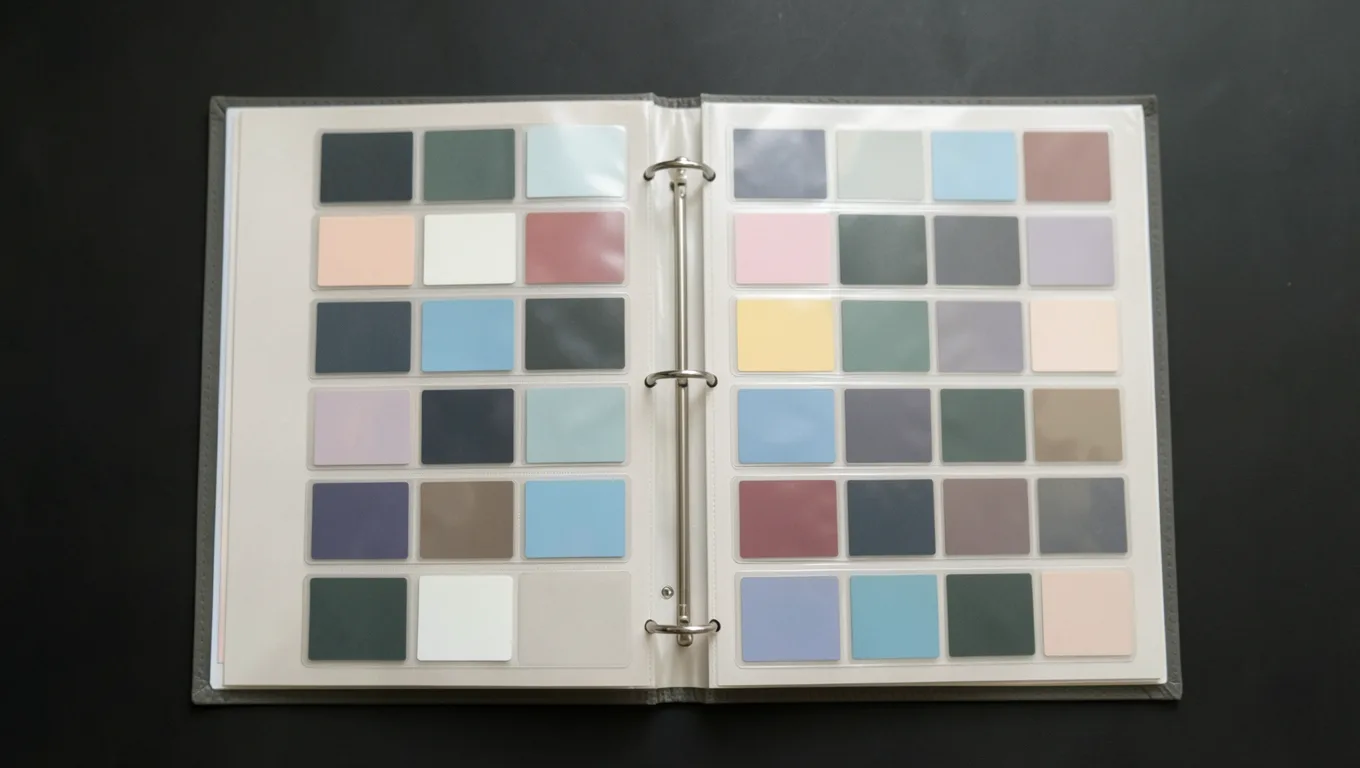
Vintage Card Centering: PSA 7 and 8 Tolerances and How SGC Compares
PSA uses one centering scale for every era: PSA 8 is 65/35, PSA 7 is 70/30, PSA 6 is 80/20, backs 90/10. How that plays out on pre-1980 cards, plus SGC's ladder.

PSA does not publish a separate centering scale for vintage cards. The same ladder applies to a 1952 Topps and a 2025 Prizm: PSA 8 is approximately 65/35 on the front, PSA 7 is 70/30, PSA 6 is 80/20, PSA 5 and 4 are 85/15, and PSA 3 down to 1.5 are 90/10. The back must be 90/10 or better for every grade from 9 through 4 (PSA 3 and below are 90/10 front and back; PSA 10 is the one exception at 75/25).
What makes vintage different is not the numbers but how often the edges of those numbers get tested. A pack-fresh modern card either passes 55/45 or it does not. A 1960s Topps card very often lands at 66/34, 71/29 or 76/24, which is exactly where PSA's two softeners apply: a stated 5% front leeway for cards grading 7 or better, and a footnote allowing "a small variance" at the grader's discretion for eye appeal. SGC's ladder is nearly identical in the middle grades (65/35 at 8, 70/30 at 7, 75/25 at 6, 80/20 at 5, 85/15 at 4) and publishes no back figure at all.
If you collect pre-1980 cards, the mid-grade lines are the ones worth memorizing, because a 4.2 mm versus 1.8 mm border split decides whether a clean-cornered 1967 Topps is a 7 or an 8, and that difference is usually more money than the grading fee.
PSA centering tolerances that matter for vintage (4 through 9)
| PSA grade | Front (published) | Back (published) | Typical vintage relevance |
|---|---|---|---|
| 9 Mint | approximately 60/40 | 90/10 | Rare on pre-1980 commons; the line a strong 8 is measured against |
| 8 NM-MT | approximately 65/35 | 90/10 | The key vintage grade; most "sharp" vintage fails here on centering |
| 7 NM | approximately 70/30 | 90/10 | Where the 5% leeway starts to apply |
| 6 EX-MT | 80/20 | 90/10 | Note the jump from 70/30 to 80/20, not 75/25 |
| 5 EX | 85/15 | 90/10 | Centering rarely the limiting factor |
| 4 VG-EX | 85/15 | 90/10 | Same centering line as 5; corners and surface separate them |
| 3 VG | 90/10 | 90/10 | Near-miscut territory |
Two details in PSA's wording are easy to miss. The word "approximately" appears at grades 7, 8 and 9 but not at 6, 5 or 4, which are written as flat "must be" figures. And the gap between PSA 7 and PSA 6 is ten points (70/30 to 80/20), twice the five-point steps elsewhere on the ladder. In practice that means a 75/25 vintage card has nowhere to go but 6 on centering unless the leeway rescues it.
PSA also states that cards "between PSA 2 and PSA 9" with high-end qualities can earn a half-point, and that "there will be a clear focus on centering" when deciding. A 1970s card with 8-grade corners and 62/38 centering is a textbook 8.5 candidate; one with 68/32 centering is a 7.5 candidate at best. A 2005 PSA comment quoted in Sports Collectors Digest reportedly framed it as: for an 8 to receive an 8.5, the card has to meet the minimum centering for the next grade up.
The full ladder, including the 10 and 9 lines and the 2025 change to 55/45, is in the PSA centering standards article.
The 5% leeway, explained with PSA's own example
PSA's standard includes a sentence that does more work on vintage than anywhere else: "A 5% leeway is given to the front centering minimum standards for cards which grade PSA 7 or better." PSA's example is a card that meets everything else for a 9 and measures 60/40 on the front, which "automatically meets" the 9 standard, while a card at 65/35 "may be deemed to meet the PSA front centering standards for PSA 9 if the eye appeal of the card is good."
Apply that to the vintage grades:
| Target grade | Published front line | With 5% leeway (eye appeal permitting) |
|---|---|---|
| PSA 9 | 60/40 | 65/35 |
| PSA 8 | 65/35 | 70/30 |
| PSA 7 | 70/30 | 75/25 |
The leeway is discretionary ("may be deemed") and only applies at 7 and above. It does not stretch a PSA 6's 80/20 to 85/15. So the honest way to read a 68/32 vintage card is: a 7 on the published line, an 8 if the grader likes the eye appeal, and never a 9.
This is also why collectors report the same measured centering coming back at different grades. A card PSA treats as an 8 with leeway and a card PSA treats as a straight 7 can be a millimeter apart on the ruler. The leeway is in the standard; its application is not something you can predict from a measurement alone.
Eye appeal: PSA's 1955 vs 1957 Koufax example
PSA's "Importance of Eye Appeal and Subjectivity" section is written with vintage in mind. It says most cards "fall clearly within the centering guidelines for a particular grade," but some fall "just within or just outside the printed centering standards," and graders "reserve the right, based on the strength or weakness of the eye appeal, to make a judgment call."
The examples PSA gives are two Sandy Koufax cards. The 1955 Topps Koufax has a low-contrast yellow background, so a borderline centering measurement may still receive the unqualified grade because the off-centering is hard to see. The 1957 Topps Koufax has a high-contrast design, and PSA says a card that "technically measures for a particular grade – let's say 70/30, may be prevented from reaching that unqualified grade because the market would view that card as off-center."
For your own cards this translates into a rule of thumb: on a vintage card with white borders against a dark photo (1957 Topps, 1971 Topps black borders, 1962 wood grain), measure and expect the published number to be enforced. On a design where border and background blend, a card on the wrong side of the line has a better chance. Neither is an excuse to skip measuring; PSA's clause covers cards "just" outside, not cards four points outside.
SGC's vintage ladder next to PSA's
SGC's published scale is structured with half grades in the 7 to 9 range, and its centering figures sit close to PSA's:
| Grade | SGC front centering | PSA front centering | Back |
|---|---|---|---|
| 10 | PRI 50/50; GM 55/45 | 55/45 (10) | SGC not stated; PSA 75/25 |
| 9 | 60/40 | approximately 60/40 | SGC not stated; PSA 90/10 |
| 8.5 | 65/35 | (PSA 8.5 is a half-point bump from 8) | SGC not stated; PSA 90/10 |
| 8 | 65/35 | approximately 65/35 | SGC not stated; PSA 90/10 |
| 7.5 | 70/30 | (half-point bump from 7) | SGC not stated; PSA 90/10 |
| 7 | 70/30 (slightly skewed diamond cut allowed) | approximately 70/30 | SGC not stated; PSA 90/10 |
| 6 | 75/25 | 80/20 | SGC not stated; PSA 90/10 |
| 5 | 80/20 | 85/15 | SGC not stated; PSA 90/10 |
| 4 | 85/15 | 85/15 | SGC not stated; PSA 90/10 |
| 3 | 90/10 | 90/10 | SGC not stated; PSA 90/10 |
Three practical differences. First, SGC is tighter than PSA at 6 and 5 on paper (75/25 and 80/20 versus PSA's 80/20 and 85/15), so a 78/22 card is an SGC 5 line but a PSA 6 line. Second, SGC's 7 NRMT description explicitly says the card "may exhibit a slightly skewed (diamond) cut," which is a real allowance for 1950s and 1960s product. Third, SGC publishes no back tolerance, which is worth knowing on vintage where backs are frequently 85/15 or worse; you cannot point to an SGC number, but you should still measure.
SGC's reputation as a vintage house is backed by the mix of what it grades. GemRate data reported by cllct for the first half of 2025 put SGC's gem rate at 21%, described as vintage-heavy, against 43% at PSA across all cards. That number says nothing about SGC being harsher on centering; it says SGC sees older, harder cards. The SGC centering standards article covers the 9.5 and 10 tiers and the tuxedo-slab market question.
One more cross-company note: Beckett's Black Label, the all-10-subgrades Pristine, is "for modern cards only — and not valid for any BVG cards (1980 and older)" per Beckett's 2014 announcement. For pre-1980 cards the realistic top-of-market labels are PSA and SGC.
Why vintage cards are off-center in the first place
Centering is decided at the factory when the printed sheet is cut, and 1950s to 1970s production had more ways to go wrong than modern rotary die cutting. Collectors who have studied the Topps process describe it in forum discussions this way: the sheet was gripped on one side while horizontal slits were cut for the rows, then a vertical blade cut off a column of cards at a time working across the sheet. Any misalignment of the image on the sheet, any sheet loaded slightly out of square, and any dulling of the blade shows up as off-center or diamond-cut cards, with the cards at the edge of the sheet typically the hardest to find well centered.
PSA's own article on the 1986-87 Fleer basketball set (modern by vintage standards, but printed on the same kind of sheets) makes the sheet-position point officially: "Poor centering, in some cases, will affect the common players even more so than the stars, depending on where the card was located on the sheet," and a collector quoted in the article lists cards 1, 11, 22, 33 and on through 132 as the ones "at the end of the sheet" that "seem to always be off-center." The same logic applies to 1960s Topps: some card numbers are chronically off-center because of where they sat.
Two consequences for graders and for you:
- Diamond cut (borders that taper from one end to the other) is a cutting artifact, not damage. SGC and BGS write allowances for it into their mid grades. Measure each border at both ends; if the left border is 2.0 mm at the top and 3.2 mm at the bottom, report the worse reading and note the skew.
- You cannot fix it. Trimming a vintage card to improve its borders is evidence of alteration; PSA's N1 no-grade is "Evidence of Trimming," and the card comes back ungraded. The why cards are off-center article walks through printing, registration and cutting in detail.
Off-center vintage: OC qualifiers and what they do to value
PSA's standard says cards that are off center "will either be designated 'OC' or will have a numerical grade that reflects the minimum centering allowed for the grade." PSA's glossary example is a card with all the qualities of an NM-MT 8 that is 90/10 left to right, which "will receive a grade of NM-MT 8oc."
Since June 2021, PSA no longer asks submitters to opt in or out of qualifiers. Marks (MK) and Miscut (MC) are still applied when warranted; OC, staining, print defect and out-of-focus "will be assigned at the grader's discretion, and most typically will impact the numerical grade rather than carrying a qualifier." So on a new vintage submission you should expect an off-center card to come back as a lower straight number, not as a 9 OC, unless the grader chooses otherwise.
For older OC slabs already in the market, collectors report a consistent rule of thumb: a qualifier costs roughly two grades of value, for example an 8 OC selling above a 6.5 but below a 7. That convention is market behavior, not anything PSA publishes. Distinguishing OC (outside tolerance) from MC (an atypical cut for the issue, sometimes showing part of the next card) matters on vintage because miscuts can carry a separate collector premium; the OC vs MC qualifiers guide covers both.
How to measure a vintage card against the 7 and 8 lines
Vintage borders are wider and rougher than modern ones, which helps precision but introduces tilt and diamond cut. The method:
- Take the card out of the sleeve or toploader. Plastic edges and glare add error.
- Scan it flat or photograph it straight down under even light. Perspective distortion ruins the ratio.
- Measure each border from the physical card edge to the outer edge of the printed border or design frame, not to the photo or artwork. Use a caliper or count pixels on the scan.
- Measure each border at two points (near each end) to detect diamond cut. Keep the worse reading.
- Compute left / (left + right) and top / (top + bottom), larger number first. Repeat for the back.
- Your centering for grading purposes is the worst axis, because PSA designates it "at the most off-center part of the card."
Worked example on a hypothetical 1960s card: left border 4.1 mm, right 2.3 mm → 4.1 / 6.4 = 64.1% → 64/36 left/right. Top 5.0 mm, bottom 3.6 mm → 5.0 / 8.6 = 58.1% → 58/42 top/bottom. Back 6.2 mm left, 1.4 mm right → 6.2 / 7.6 = 81.6% → 82/18 back. Worst front axis is 64/36, just inside PSA's 65/35 line for an 8 and inside SGC's 65/35 for 8 or 8.5. Back 82/18 passes the 90/10 back requirement. This card's centering supports an 8; corners, surface and any creases decide the rest.
Second example: left 4.8 mm, right 1.9 mm → 4.8 / 6.7 = 71.6% → 72/28. That misses PSA 8's 65/35 and sits just outside PSA 7's 70/30. On published lines it is a 6 on centering; with the 5% leeway at 7 and good eye appeal, it "may be deemed" a 7. This is the card where the Koufax logic matters.
The free card centering calculator does the arithmetic from a photo in your browser with manual guide lines, reports both axes for front and back, and maps them to the PSA, BGS, CGC, SGC and TAG standards, which is useful when you are sorting a stack of vintage commons into "send" and "keep raw" piles. The full measuring method with precision notes is in how to measure card centering at home.
Bottom line
- PSA uses one centering scale for all eras: 8 is approximately 65/35, 7 is 70/30, 6 is 80/20, 5 and 4 are 85/15, backs 90/10 from 9 down to 4.
- PSA's 5% front leeway for grades 7 and up and its eye-appeal footnote are what make vintage grading feel variable; they are discretionary, not automatic.
- SGC's ladder matches PSA at 8 and 7 (65/35, 70/30) but is tighter at 6 and 5 (75/25, 80/20), allows a slight diamond cut at 7, and publishes no back figure.
- Off-center vintage now usually comes back as a lower straight grade rather than an OC qualifier; existing OC slabs trade roughly two grades down, collectors report.
- Measure to the printed border, at two points per side, worst axis wins, and never trim.
Frequently asked questions
What is the centering requirement for a PSA 8 on a vintage card?
PSA's published standard for NM-MT 8 is approximately 65/35 or better on the front and 90/10 or better on the reverse, and PSA does not publish a separate vintage scale. PSA also gives itself a 5 percent front leeway for cards grading 7 or better, so a card that measures 70/30 with strong eye appeal may still be deemed to meet the 8 standard at the grader's discretion.
What is PSA 7 centering?
PSA NM 7 requires centering of approximately 70/30 or better on the front and 90/10 or better on the back. In millimeters, if the two side borders add up to 6 mm, a 70/30 card has one border at 4.2 mm and the other at 1.8 mm. PSA's 5 percent leeway for grades 7 and up means a 75/25 card with good eye appeal can sometimes be judged to meet the PSA 7 front line.
Does PSA grade vintage centering more leniently than modern?
Not officially. PSA publishes one set of centering tolerances for all cards. What changes on vintage is how often the eye-appeal clause and the 5 percent leeway for PSA 7 and above come into play, because more pre-1980 cards land near the 65/35 and 70/30 lines. PSA's own example uses 1955 and 1957 Topps Koufax cards to show that a low-contrast background can earn a pass that a high-contrast card would not.
Is SGC better than PSA for vintage centering?
SGC's published ladder is close to PSA's in the middle grades: SGC 8 and 8.5 are 65/35, SGC 7 and 7.5 are 70/30, SGC 6 is 75/25, SGC 5 is 80/20 and SGC 4 is 85/15. SGC does not publish a back tolerance. SGC's volume is vintage-heavy, and GemRate data reported by cllct put its first-half 2025 gem rate at 21 percent, which reflects the older cards it sees rather than a looser or stricter centering rule.
What does an OC qualifier do to a vintage card's value?
PSA's standard says off-center cards either receive an OC qualifier or a numerical grade that reflects the minimum centering allowed for the grade, and since June 2021 PSA applies OC at the grader's discretion, usually by lowering the number instead. Where an OC label exists, collectors report it trades roughly two grades below the unqualified grade, for example an 8 OC selling above a 6.5 but below a 7.
Can a diamond-cut vintage card still grade well?
Yes, within limits. SGC's 7 NRMT description allows a slightly skewed, or diamond, cut. Beckett allows very slight diamond cutting at 7, slight at 6 and 5, moderate at 4 and 3, and noticeable at 2. PSA does not list diamond cut allowances by grade; a cut that is abnormal for the issue can receive the MC qualifier or an N8 miscut no-grade. Measure both ends of each border to detect it.