Yu-Gi-Oh! Card Centering: How to Measure Cards With Dark Borders
Yu-Gi-Oh! centering explained: where the measurable border is on the YGO frame, handling dark and holo borders, back centering, and PSA, BGS, CGC and TAG limits.
A Yu-Gi-Oh! card needs the same centering as anything else to gem: approximately 55/45 on the front and 75/25 on the back for a PSA 10, with the worse of the two axes governing. PSA 9 loosens to approximately 60/40 and 90/10. BGS wants 55/45 both ways on the front for a 9.5, CGC's Gem Mint 10 matches PSA, and TAG's Gem Mint band is approximately 55/45 front with a 65/35 back for TCG cards. Nobody publishes a Yu-Gi-Oh!-specific rule.
Two things make Yu-Gi-Oh! genuinely harder to measure than most cards, and neither is about the standards. First, the cards are smaller than the hobby default, roughly 59 x 86 mm against the 63.5 x 88.9 mm standard, so every measurable band is narrower and a given measurement error buys you more ratio points than it would on a Pokémon card. Second, several frame colors are dark, and a black Xyz frame photographed on a black play mat has no findable cut edge at all.
This guide walks the YGO frame, says where the measurable border is on each axis, covers dark frames and foil glare, separates holo misregistration from real off-centering, lists the tolerances at every grader, and finishes with a repeatable routine.
Anatomy of a Yu-Gi-Oh! card for centering purposes
Yu-Gi-Oh! cards share one layout with a colored frame that identifies the card type. From the top down on a monster card: the card name, an attribute symbol at the top right, a row of level stars (rank stars set to the left on Xyz cards), the artwork box, the monster type and ability line, the effect or lore text box, the ATK and DEF values at the lower right, and a line of set code, edition text and passcode along the bottom. Spell and Trap cards drop the level row and the ATK/DEF line and add a property icon beside the name. Around all of it runs the card frame in its type color, out to the cut edge, and the band of frame color between the cut edge and the interior elements is what you are measuring.
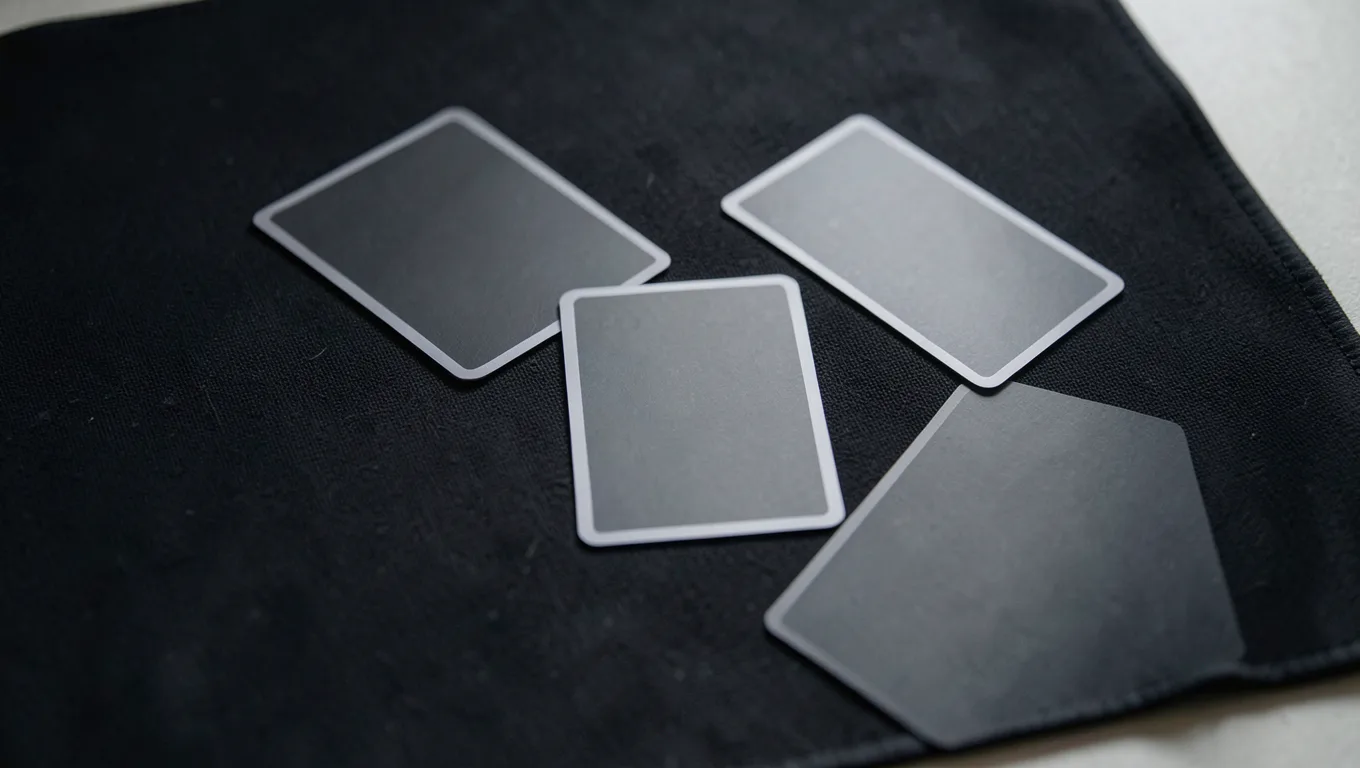
The colors that matter here are the dark ones. Normal and Effect monster frames are light, so the cut edge stands out against a dark surface. Xyz frames are essentially black, Link frames are dark, and plenty of Spell and Trap frames read dark under warm indoor light. On those, reverse the usual advice and shoot against white.
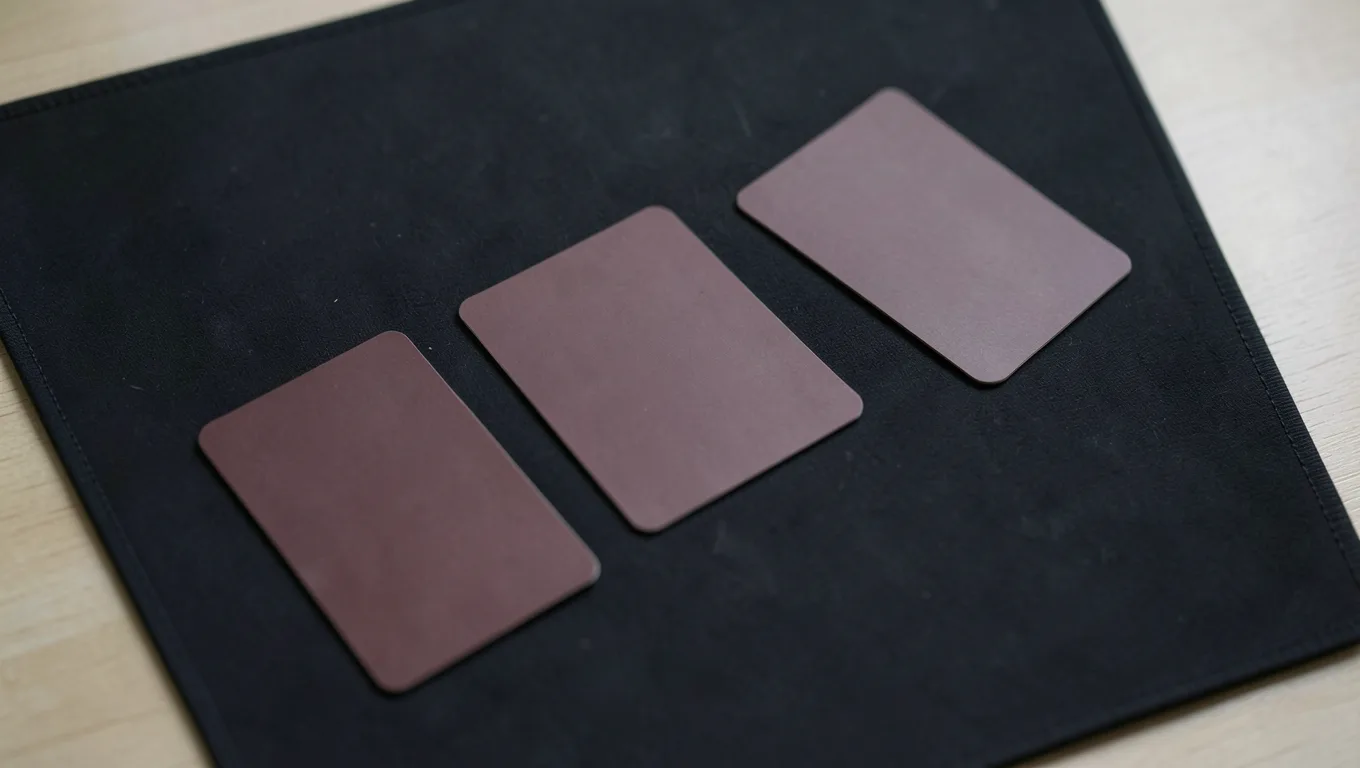
The back. Every Yu-Gi-Oh! card shares a single brown back with a symmetrical central emblem inside an inner frame line. Because that design is identical on every card in the game, the back is the most reliable surface for a clean four-sided measurement and it carries its own published tolerance at most graders: PSA, BGS, CGC and TAG all state a back figure, while SGC publishes none at any grade. On a YGO card the back is not a formality; it is often the only place you can get an honest top-to-bottom number.
Where the measurable border actually is
This is the part that trips people up, because the two axes are not equally easy.
Left and right: use the art box. The vertical bands of frame color running down either side of the artwork box are designed to be equal on a well-cut card. Measure from each cut edge to the outer line of the art box, at the same height on both sides. That is a clean symmetric pair and it gives you a left/right ratio you can trust.
Top and bottom: measure like to like, then verify. There is no symmetric pair on this axis. The top band carries the name text and the bottom band carries the set code and passcode line, and they are not designed to be identical widths in millimeters, so a wider top band does not by itself mean the card is off-center. Pick one line at the top and its counterpart at the bottom that both belong to the frame itself (the frame's inner boundary, not a text element), measure cut edge to that line on both, compute the ratio, then cross-check it against the back, which is symmetric and unambiguous. Where you can, compare against high-resolution images of the same printing in a top-grade slab; differences of a few tenths of a millimeter are obvious side by side and invisible in isolation.
If the front and back top/bottom readings disagree badly, trust the back for the number and treat the front as a reason to look harder. Fronts and backs are printed in separate passes and registered to the sheet independently, so they genuinely can differ; that is normal, and it is why PSA, BGS, CGC and TAG each publish a separate back tolerance. More on that in does back centering matter?
Never measure to the artwork. The art, the name and the text box are printed in a fixed relationship to the frame. Only the position of the cut relative to the whole printed sheet changes from copy to copy. You are measuring the cut.
Why the smaller card size costs you precision
Yu-Gi-Oh! cards being smaller is not a cosmetic detail; it changes how much your measurement error matters. Take two cards where the combined left-plus-right border across an axis is 6.0 mm on one and 3.6 mm on the other:
| Combined border across the axis | 50/50 | 55/45 | 60/40 | mm gap between the 10 line and the 9 line |
|---|---|---|---|---|
| 6.0 mm (a wide frame) | 3.00 / 3.00 | 3.30 / 2.70 | 3.60 / 2.40 | 0.60 mm |
| 3.6 mm (a narrow frame) | 1.80 / 1.80 | 1.98 / 1.62 | 2.16 / 1.44 | 0.36 mm |
On the narrow frame, the entire distance between "published PSA 10" and "published PSA 9" is about a third of a millimeter of difference between opposite borders. A handheld phone photo with a couple of degrees of tilt can introduce that much error by itself. So for Yu-Gi-Oh!, scan or shoot from a fixed straight-down position, and treat any handheld reading within three points of a threshold as unresolved. Conversion tables for other border widths are in what centering ratios mean in millimeters.
Dark frames, foil glare, and making the cut edge visible
Most centering guides tell you to lay the card on a dark matte surface. For a black Xyz frame or a dark Link frame that advice is actively wrong.
- Match the background to the border, in reverse. Light frames on a dark mat, dark frames on white paper. All that matters is that the cut edge has contrast against what is behind it.
- Scan instead of photographing. A flatbed with the lid closed surrounds the card with an even white field, removes perspective error entirely, and has a known scale: at 600 dpi one millimeter is roughly 24 pixels. On a narrow-bordered dark card that precision is not a luxury.
- Light foils from two low angles. Ultra, Secret and the premium rarities throw hard highlights. Two diffuse sources from opposite sides, or open shade, keeps the frame lines readable; a single overhead lamp erases the line you are measuring to.
- Take the card out of the sleeve. A penny sleeve adds a bright seam exactly where the cut edge is, and on a dark card your eye and any edge detector will both grab it instead.
- Two readings per border. A card cut slightly off square tapers, so a side that reads 1.7 mm at the top can read 2.0 mm at the bottom. One reading averages a good end with a bad end.
Holo shift is not off-centering
A common Yu-Gi-Oh! question is whether a foil layer that looks slightly offset counts against centering. It does not, and knowing the difference saves you from downgrading a card that is fine.
Centering is about where the guillotine came down relative to the printed image. It shows up as unequal opposite borders, uniformly along their length.
Foil or holo misregistration is one printed layer sitting slightly off from the layers underneath it. It shows up as a fringe, a doubled edge, or foil creeping past a printed boundary. It does not change the width of your borders at all, so it does not change your ratio.
Graders score the two under different criteria. Centering has its own published ladder; a misregistered layer is a printing or surface issue, and PSA's Gem Mint 10 description allows one slight printing imperfection that does not impair the card's overall appeal. The practical rule: measure to the printed frame lines, not to the edge of the foil. Where the two disagree, the printed line is your reference.
Yu-Gi-Oh! centering tolerances at every grader
All figures are from the companies' official standards pages, verified August 2026. Yu-Gi-Oh! is a TCG, so where TAG splits sports and TCG the TCG figure is shown. CGC publishes numeric ratios below Gem Mint 10 only for sports and non-sports cards, and states none for TCG at 9 and below.
| Grader / grade | Front (worse axis) | Back |
|---|---|---|
| PSA 10 Gem Mint | ~55/45 | 75/25 |
| PSA 9 Mint | ~60/40 | 90/10 |
| PSA 8 NM-MT | ~65/35 | 90/10 |
| PSA 7 NM | ~70/30 | 90/10 |
| BGS 10 Pristine (Gold or Black Label) | 50/50 | 55/45 |
| BGS 9.5 Gem Mint | 55/45 both ways | 60/40 |
| BGS 9 Mint | 55/45 both ways | 70/30 |
| BGS 8 NM-MT | 60/40 both ways | 80/20 |
| CGC Pristine 10 | 50/50 | not stated |
| CGC Gem Mint 10 | ~55/45 | 75/25 |
| SGC 10 Pristine / 10 Gem | 50/50 / 55/45 | not stated |
| SGC 9 Mint | 60/40 | not stated |
| TAG 10 Pristine (990-1000) | ~51/49 | ~52/48 (TCG) |
| TAG 10 Gem Mint (950-989) | ~55/45 | ~65/35 (TCG) |
| TAG 9 Mint (900-949) | ~60/40 | ~75/25 (TCG) |
Reading it for a YGO card: PSA and CGC are the most generous on the back at the top grade, at 75/25. BGS is the strictest on both faces, and note that BGS 9 keeps the front at 55/45 and only loosens the back, so BGS 9 front centering is exactly as demanding as BGS 9.5. Beckett's figures describe the centering subgrade, not the final number, because Beckett states the final grade is not a simple average and that the lowest subgrade is the most heavily weighted. TAG's TCG back figure of about 65/35 at Gem Mint is meaningfully tighter than PSA's 75/25, which matters on a game where the back is the surface you can measure best. The complete ladder is in the centering tolerance by grade table, and the same thresholds are on the grading standards guide.
Worked example
An Ultra Rare on a dark frame, out of the sleeve, scanned at 600 dpi.
- Front left band 2.1 mm, right band 1.7 mm. Total 3.8 mm. 2.1 / 3.8 = 55.3%, so 55/45 left to right.
- Front top band 2.4 mm, bottom band 1.9 mm, measured frame line to frame line. Total 4.3 mm. 2.4 / 4.3 = 55.8%, so 56/44 top to bottom.
- Back top 2.6 mm, bottom 1.8 mm. Total 4.4 mm. 2.6 / 4.4 = 59.1%, so 59/41 on the back.
The worse front axis is 56/44 and the worse back axis is 59/41. Nobody averages the two axes: PSA states that centering is designated as the percent of difference at the most off-center part of the card, and BGS writes its figures as applying both ways. That rule gets its own article, both axes off-center and the worst-axis rule. Placing the numbers:
- PSA and CGC: 56/44 is one point past the approximate 55/45 line, so inside the word "approximately." PSA's published 5% front leeway applies to cards grading 7 or better, so a 10 is genuinely on the table if the rest of the card is clean. The 59/41 back is comfortably inside 75/25.
- BGS: 56/44 fails 55/45 both ways, the line for both 9.5 and 9; 60/40 both ways is the BGS 8 line. The 59/41 back passes 9.5's 60/40 by a hair. Centering subgrade lands around 8.
- SGC and TAG: past the 55/45 Gem line, so 60/40 at SGC 9 and ~60/40 at TAG Mint 9. The 59/41 back clears both TAG's ~75/25 Mint 9 TCG figure and its ~65/35 Gem Mint TCG figure, so on this card the front is the number doing all the capping.
One measured card, several ceilings, all of it decided before anyone looked at a corner.
1st Edition, Unlimited and print-run talk
Yu-Gi-Oh! collectors argue constantly about whether particular eras or editions are cut better. Be careful with this. No grading company publishes set-level or edition-level centering data, and population reports mix condition, submission behavior and card scarcity together, so they cannot cleanly answer the question either.
What can be said honestly:
- The 1st Edition line under the art box tells you which print run the card came from. It is a rarity and value marker, not a condition marker.
- Collectors report that certain early print runs produce more off-center copies than later ones. That is community observation, not data.
- Centering is set at the factory when the sheet is cut, so a sealed, never-played card can be 65/35 and flawless everywhere else. Pack fresh means clean corners and surface; it does not mean centered.
- When a whole run leans the same way, the effect is to make the well-centered copies scarce, not to make the off-center ones desirable. The mechanics are in why trading cards are off-center.
Off-center or miscut?
If one band is missing entirely, the frame is clipped, a strip of a neighboring card shows along an edge, or the card is visibly a different size from the rest of your binder, that is not bad centering. It is a miscut, and the ratio stops being a useful description. PSA's MC qualifier covers any card exhibiting an atypical cut for the issue, which may result in portions of the card being cut off or more than one card being visible, and PSA lists an N8 Miscut no-grade for cuts abnormal enough that it declines to grade at all, with no grading fee charged. The full breakdown is in off-center vs miscut: OC and MC qualifiers.
A repeatable routine
Card out of the sleeve: dark frames on white paper, light frames on a dark mat, or straight onto a flatbed at 600 dpi. Take two readings per side. Front left/right runs cut edge to the art box outline; front top/bottom runs frame line to frame line; then measure all four sides of the brown back, which is your most trustworthy number. Write down the worst front axis and the worst back axis, find the highest row in the table where both pass, and treat it as your centering ceiling at that company. Anything within three points of a line on a card this small is unresolved, so re-measure by scan or caliper before paying a fee.
The free card centering calculator does the measurement and the mapping from a photo in the browser, with guide lines you drag onto the frame lines yourself, which is what you want on a dark narrow frame where automatic edge detection has the least contrast to work with. The general hand method is in how to measure card centering, and if you also grade Pokémon, the equivalent frame-by-frame breakdown is in the Pokémon card centering guide.
Bottom line
- Yu-Gi-Oh! is graded on the standard tolerances: PSA 10 is ~55/45 front and 75/25 back, BGS 9.5 is 55/45 both ways and 60/40 back, CGC Gem Mint 10 matches PSA, TAG Gem Mint is ~55/45 front and ~65/35 back for TCG. There is no YGO-specific rule.
- Left/right is easy: cut edge to the art box outline on both sides. Top/bottom has no symmetric pair, so measure frame line to frame line and verify against the symmetrical brown back.
- The cards are smaller, roughly 59 x 86 mm, so bands are narrower and the gap between the 10 and 9 lines can be about a third of a millimeter. Scan; do not eyeball.
- Dark frames need a light background, not the dark mat every guide recommends. Foils need two diffuse lights or a scanner.
- A shifted foil layer is print registration, not centering. Measure to the printed frame lines.
- 1st Edition tells you about the print run and the price, not about your copy's cut. Measure the card in front of you.
Frequently asked questions
What centering does a Yu-Gi-Oh! card need for a PSA 10?
The same as every other card. PSA's published Gem Mint 10 standard is centering within approximately 55/45 on the front and 75/25 on the reverse, and the worse of the left/right and top/bottom axes is the number that counts. PSA 9 allows approximately 60/40 front and 90/10 back. No grading company publishes a Yu-Gi-Oh!-specific tolerance.
Where do you measure centering on a Yu-Gi-Oh! card?
Left to right, measure from each cut edge to the outer line of the artwork box; those two bands are designed to be equal, so they give you a clean ratio. Top to bottom is harder because the top and bottom bands are not designed to be the same width, so measure like to like, cross-check against the back, and compare with a known well-centered copy of the same print.
Why are Yu-Gi-Oh! cards harder to measure than Pokémon cards?
Two reasons. Yu-Gi-Oh! cards are smaller, roughly 59 x 86 mm against the 63.5 x 88.9 mm standard used by Pokémon and Magic, so the measurable bands are physically narrower and the same measurement error costs you more ratio points. And several card types use dark frames, so the cut edge disappears against a dark background in a photo.
Does a shifted holo layer count as off-center?
No. Centering describes where the cut landed relative to the printing. If the foil or holo layer is slightly misregistered against the printed art underneath, that is a print registration fault on one layer, and it shows as a fringe or a doubled edge rather than as unequal borders. Graders score it under printing and surface, not centering. Measure to the printed frame lines, not to the foil edge.
Does back centering matter on Yu-Gi-Oh! cards?
Yes, and the YGO back is the easiest surface on the card to measure because the brown back design is identical on every card and symmetrical. PSA allows 75/25 on the reverse for a 10 and 90/10 for a 9; BGS wants 55/45 for a Pristine 10 and 60/40 for a 9.5; TAG's TCG back figure is approximately 65/35 for Gem Mint and 52/48 for Pristine. SGC publishes no back figure at any grade.
Are 1st Edition Yu-Gi-Oh! cards centered worse than Unlimited?
There is no published data either way, and we will not invent any. Collectors report that certain early print runs are inconsistent and that centering complaints cluster around them, but a 1st Edition stamp tells you about the print run, not about your specific copy. Measure the card in front of you; the stamp changes what the card is worth, not what it measures.